SINCE 1957
Rider's pride

SINCE 1957
Rider's pride
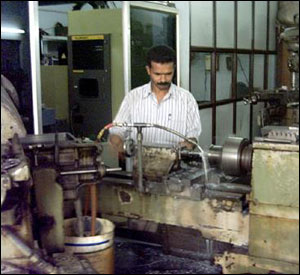
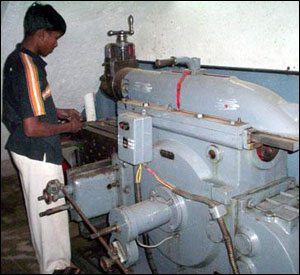
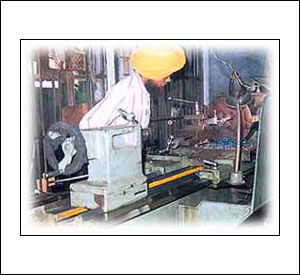
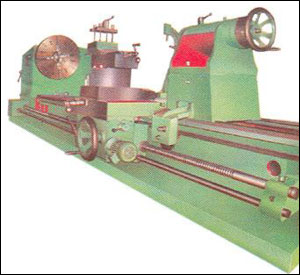
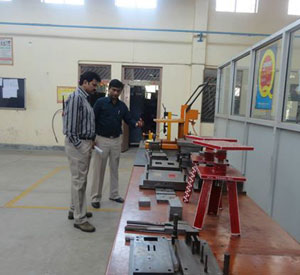
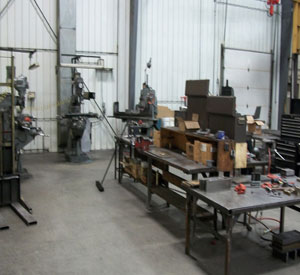
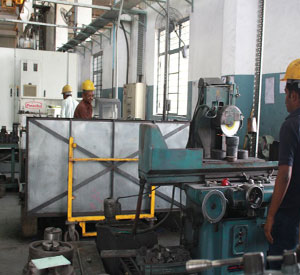
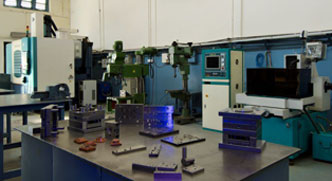
Our Tool room is well equipped with modern facilities & traditional facilities for the smooth working on New Models, Dies, Punches & also to avoid production brake downs i.e. Lathe Machines, Welding Sets Etc. Some of them are given below:-
Lathe is oldest most common turning machine holds and rotates metal or wood while a cutting tool shapes the material. The tool may be moved parallel to or across the direction of rotation to form parts that have a cylindrical or conical shape or to cut threads. With special attachments, a lathe may also be used to produce flat surfaces, as a milling machine does, or it may drill or bore holes in the work-piece.
Shaper is used primarily to produce flat surfaces. The tool slides against the stationary work-piece and cuts on one stroke, returns to its starting position, and then cuts on the next stroke after a slight lateral displacement. In general, the shaper can produce almost any surface composed of straight-line elements.
Planer is the largest of the reciprocating machine tools. Unlike the shaper, which moves a tool past a fixed work-piece, the planer moves the work-piece past a fixed tool. After each reciprocating cycle, the work-piece is advanced laterally to expose a new section to the tool.
Milling, a work-piece is fed against a circular device with a series of cutting edges on its circumference. The work-piece is held on a table that controls the feed against the cutter. The table conventionally has three possible movements: longitudinal, horizontal, and vertical; in some cases it can also rotate. Milling machines are the most versatile of all machine tools. Flat or contoured surfaces may be machined with excellent finish and accuracy. Angles, slots, gear teeth, and recess cuts can be made by using various cutters.
Drilling and Boring Machines These type of machinery particularly useful in large-scale production, these power tools produce uniform holes and smooth surfaces far faster and more accurately than they could be produced by hand.
Hole-Making machine tools are used to drill a hole where none previously existed; to alter a hole in accordance with some specification (by boring or reaming to enlarge it, or by tapping to cut threads for a screw); or to lap or hone a hole to create an accurate size or a smooth finish.
Drilling Machines vary in size and function, ranging from portable drills to radial drilling machines, multi-spindle units, automatic production machines, and deep-hole-drilling machines. See Drill.
Boring is a process that enlarges holes previously drilled, usually with a rotating single-point cutter held on a boring bar and fed against a stationary work-piece. Boring machines include jig borers and vertical and horizontal boring mills.
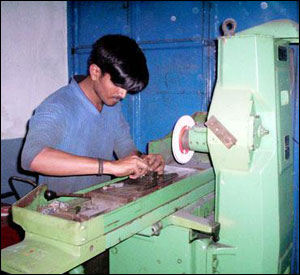
Grinding is the removal of metal by a rotating abrasive wheel; the action is similar to that of a milling cutter. The wheel is composed of many small grains of abrasive, bonded together, with each grain acting as a miniature cutting tool. The process produces extremely smooth and accurate finishes.
To provide best quality to our customers, we are using good quality lubricants & cooling fluids. In many cutting operations fluids are used to cool and lubricate. Cooling increases tool life and helps to stabilize the size of the finished part. Lubrication reduces friction, thus decreasing the heat generated and the power required for a given cut. Cutting fluids include water-based solutions, chemically inactive oils, and synthetic fluids.