SINCE 1957
Rider's pride

SINCE 1957
Rider's pride
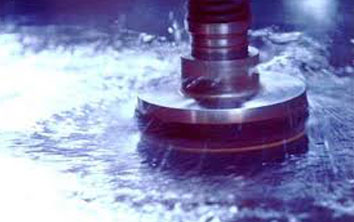
Polishing also consist of Grinding which is the first operation done by us for the smoothen surface. Grinding & Polishing are two abrasive processes for shaping and smoothing hard materials such as metal. Polishing uses extremely fine abrasive substances, such as putty powder, and emery dust, to rub or burnish an extremely smooth and brilliant finish on the surface of a material. The polishing materials are coated on the surface of cloth, felt, or leather wheels. One special type of polishing wheel is made of soft rubber with the abrasive grains molded into it.
Other two special finishing operations are also used in metalworking which are honing and lapping. Honing improves the accuracy and finish of automobile cylinder bores, hydraulic cylinders, and similar parts. Lapping is done by rubbing a surface with an abrasive lubricated with oil, grease etc. This operation is usually performed with a tool called a lap that matches the contour of the surface being finished. The lap is spread with a thin layer of the abrasive, and the two parts are then rubbed together with irregular strokes.
Grinding is actually a cutting operation in which each grit that comes in contact with the material cuts out a minute chip. Grinding wheels usually consist of emery cloth or leather coating used on the wheel. Grinding can be coarse or fine, depending on the size of the grit used in the grinding wheel & the requirement of the product. Metal and glass can be ground to a mirror finish
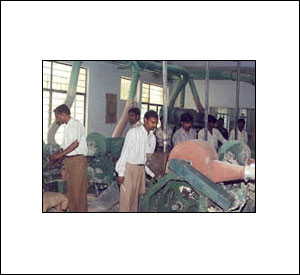
Grinding machines are machine tools equipped with precision grinding wheels and suitable means for holding, positioning, rotating, or traversing the work-piece so that it can be ground to the desired size, shape, and finish. The grinding wheel is mounted on a motor-driven spindle. Grinding machines are usually classified according to the shape of the work-piece being ground (i.e. Axle, Chainwheel & Crank Shaft), the manner in which it is held or supported, and the structure of the machine.
Abrasive belt finishing is a very best method for finishing metal, relatively fast finishing process. With the development of better resin bonded belts having increased flexibility and improved joints coupled with improvements in machinery, the versatility of the process has reached even greater acceptance on the production line. Abrasive belt finishing is now an important size and surfacing process for the precision finishing of flat, concave, and convex surfaces,
Stock removal is accomplished by the abrasive grains on a moving belt as they continuously pass over the work area. In this way, burrs, high spots, the coarse texture on cast parts, parting lines, or machining marks are refined or totally removed from a workpiece.
Most production belt grinding and polishing operations use a lubricant that is applied at frequent intervals. Aluminum alloys are finished dry. Belt life is extended by using a series of coated belts of varying degrees of abrasive fineness, usually roughing, polishing, and fine polishing. The final surface finish produced is superior to that obtained by milling or turning. Inspite of the term "fine polishing," however, the resulting surface on the workpiece is always characterizes by fine scratches or gritlines.
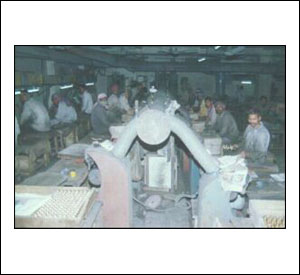
Most belt finishing machines consist of a motor driven contact wheel and idler arrangement over which an endless coated-abrasive-tensioned belt rides. Flat finishing requires a sturdy support pattern. Contoured finishing, can be performed by rotating the part against a flat contact wheel, against a formed contact wheel, or offhand, entirely against the moving belt without support. Tubing and rolls may be finished in centerless abrasive belt machines. Fixtures are often used to simplify parts handling in repetitive operations on large production runs. Wide sheet and coil stock are finished by abrasive belt machines in a smooth and continuous motion.
Polishing, or flexible grinding, is an intermediate, dimensionless step in the formation of a finished surface. It is generally preceded by grinding with a solid abrasive wheel and followed by buffing. A polished surface is accomplished by the cutting action of millions of small abrasive grains adhering to an endless coated belt or flexible wheel as they wear away the metal. The complete polishing sequence usually involves several steps, first to remove the initial scratches and defects and then to gradually impart the final surface condition.
In addition to the many product applications already listed under belt finishing, manufacturers of cutlery and small hand tools are particularly dependent upon polishing for finishing. This process is also used for such work as "stain finishing," deburring, and for cleaning up irregularly shaped parts prior to plating or buffing.
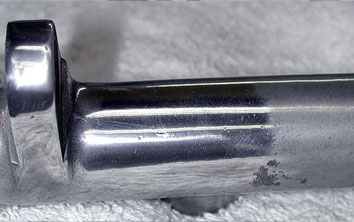
Buffing generally follows polishing and is usually the final operation that is performed on a workpiece. In buffing, the rubbing action is more gentle than the vigorous and aggressive cutting action employed in polishing. Buffing removes negligible amounts of material. A buffed surface is formed in two distinct steps: 1.) Cutting down and 2.) Coloring. During the initial finishing stage of cutting down, minute scratches left by polishing and other surface irregularities are reduced or entirely eliminated. It is during the final stage of buffing (coloring) that the ultimate reflective, highly lustrous surface is produced.
Buffing wheels, called "buffs," are often fabricated into a number of piles from a series of individual fabric disks of various kinds. Buffing wheel speeds are in the range 6500 to 8000 fpm.
The principle abrasive used for buffing compounds on aluminum, copper, brass, and for zinc alloy die castings is Tripoli. The buffing compounds may be manually applied to metal products in the same manner as is outlined for polishing (i.e., solid bar compound). The compound may be also be supplied to the wheel face in liquid form by using a patented airless -spraying system. Liquid compounds are highly suitable for machine or automatic buffing.